展覽日期: 2009年3月01日 ﹣ 2009年3月14日
開幕時間: 2009年2月28日,17:00
展覽空間: 上海樂天陶社
策展人: 鄧凝梅、余琦琦
藝術家: 陳錦成、陳慧思、鄭志明、蔡穎思、香建峰、何藹恩、林志光、林玉蓮、李美娟、林偉而、鄧凝姿、鄧凝梅
主辦機構: 純粹獨立藝術家群
當地球仍在轉動,還沒有貌似奇洛李維斯的外星人走出來(說普通話)警告我們,可見與不可見的萬物仍流動於四周,外有宇宙,內有流感,還有近期全球人類關注的經濟流動性。藝術,不論是昔日權力的宣傳工具,還是今天反映時代的鏡子,它都具有溝通的能力。當藝術品在移動時,作品的內容與周圍的環境或人會產生一定的對話。這次展覽由高流動性的作品組成,在「十三個手提藝術的故事」中,我們從不同的生活層面去探索人與人之間為交流而作的準備及過程。
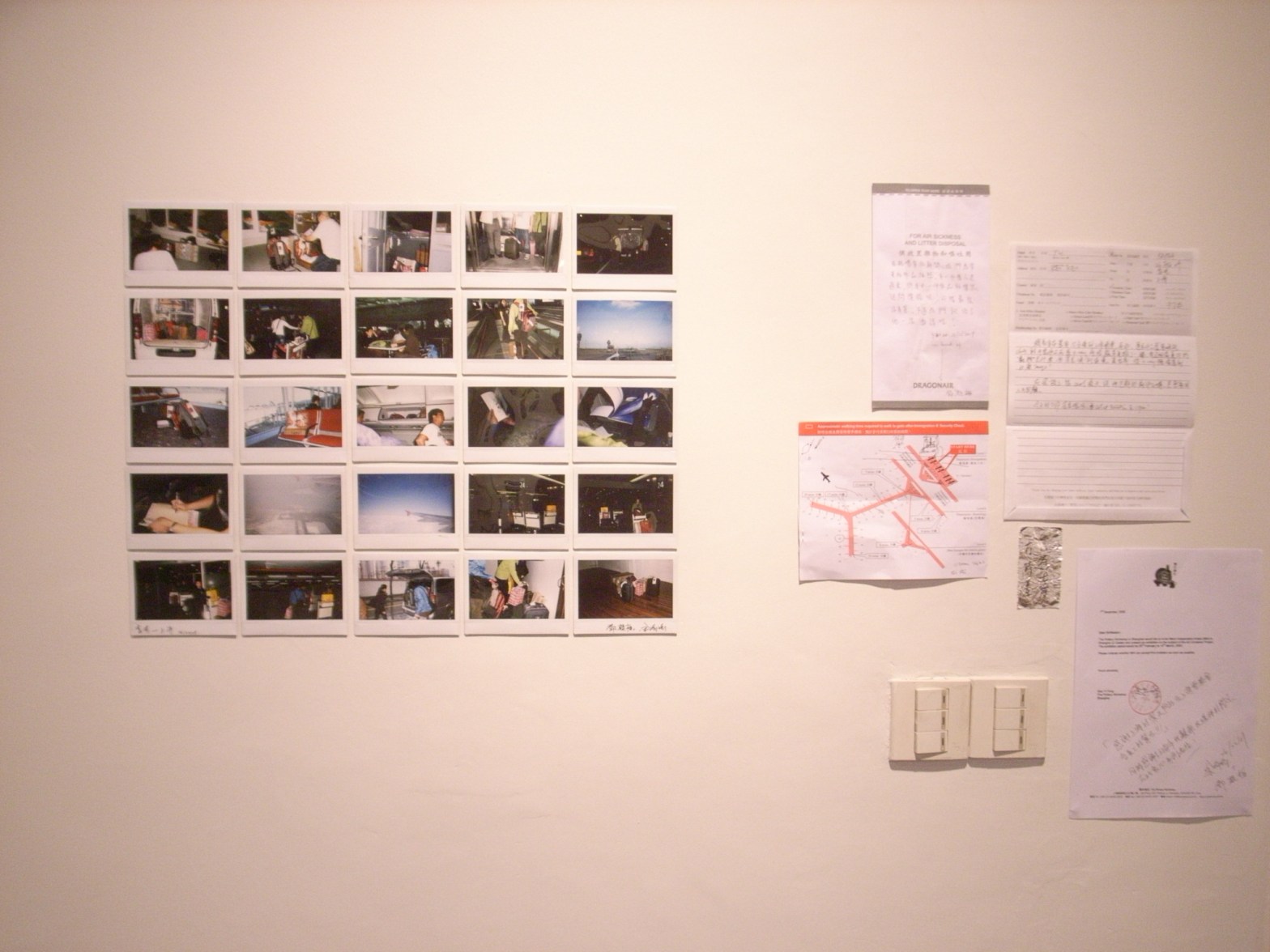
「手提藝術」正是今次跨境展覽的「行動」部分,我們以策展人的身份,邀請十二位香港藝術家製作在尺寸上和重量上都方便攜帶的藝術品,之後我們會挑、抱、背、提、扛或搬,將作品運出香港。在運送途中,我們會用攝影記錄手提藝術在不同轉換點,如地下鐵、的士站或機場內等情況。最終的相片記錄會成為展覽的第十三個手提藝術的故事,描述著其餘十二件藝術品的流動過程,為「十三」揭開序幕:
從來,有人的地方就有垃圾,它是文明的副產品。當物質文明不斷發展,所製造出的垃圾就更多、更複雜,打從何時開始城市的發展都建基於垃圾堆之上?林玉蓮利用旅行箱載滿了一匧過剩的物質文明產品,從香港運到上海,再在展場中野蠻地展開,讓物質文明霸佔的地面空間成為她的裝置作品。因人性的過度貪婪而導致世界毀滅的電影、電視劇或漫畫有很多,其中在七十年代發表的恐怖漫畫《漂流教室》就是其中一個經典,鄭志明以裝置作品去表達文明的漂流故事,叫現代世界當心。的確,恐怖襲擊到處都是,出入國境變得緊張,為安全而作的檢查自然繁瑣。因為恐懼,所以加強監管,要進入「文明」的城市就得留下記號,如鄧凝梅的《打指毛》,不論是人是畜,通通需要清白的印記。
關於提運行李的重量及尺寸限制,一般都有清楚的規定。對於林偉而的《旅行箱內的一生》來說,要把人整整的一生壓縮到一個旅行箱內,其重量會是多少?當陳錦成的旅行箱通過機場的X光射線安全檢查儀時,檢查人員會看到旅行箱內置海綿製的世界六合(鹿鶴),天南地北的尺寸又是多少?
有人說地理是要用身體體驗出來的,文字只是後備,李美娟的《旅程日誌》正正脫離了文字的空間,只有心電圖般的線條來表達旅程中的微妙震動。在旅途中閱讀絕對是打發呆等時間的好提議,在選擇讀物時,大家不妨考慮陳慧思藍色的《閱讀水平線》和何藹恩的《黑色旅遊指南》,前者是對時間和距離認知提出了新的看法,後者則是以圖畫故事來描繪一個看不見的城市的旅遊經歷。在上海,林志光展出陶瓷作品《藍白色的器皿》,在海上,他的藝術貨櫃正經南中國海、印度洋到達波斯灣各地,重複著古代海上絲綢之路的航線。
香港的維多利亞港,港濶水深,為天然良港,怪不得當年的商界精「英」硬要從滿清政府手上奪去。現時維港的西北部,已發展成為香港最主要的貨櫃物流處理中心──葵青貨櫃碼頭,它是全球最高吞吐量的貨櫃港口之一。當日,香建峰就是從那裏出發,伴隨自己所繪畫的貨櫃到新加坡,在五天的海上旅程中他創作了《當貨櫃船遇上鯨魚》。若要在維港上捕魚,能捕獲的魚類可能包括了蔡穎思提及的白飯魚,雖然今天的維港海產不宜食用,但仍有機會發現白飯魚(白色的帆布鞋)漂浮在維港上。香港由英殖民地轉變為一個特別行政區,由一個小小漁港轉變為每晚有大型燈光音樂匯演的城市,活於浩浩蕩蕩的大潮流下,人的改變是出於選擇,還是身不由己?鄧凝姿在本身美麗的尼龍紗上默默地車縫黑色綿線,使透明輕薄的布料變得堅挺,並製作成拉鍊式的高領衣服。高領被拉上後,外界不會看到穿者的眼睛,但穿者能透過透明的布料去觀察外界。在這個高度流動性的社會中,人群無時無刻地流動,作為穿梭於其間的一份子,是去看的或是被看?周圍的環境是和諧或是喧鬧?人與人之間是共存還是缺裂?
「十三個手提藝術的故事」是藝術貨櫃計劃第二階段的交流活動,以展覽形式與香港以外的城市作文化交流,因此,每件作品需經歷一段「肉體」旅程,由香港被「手提」到上海作展出。基於這個動作,展覽的內容便自然地與流動性扯上關係。透過手提的藝術作品作溝通媒介,串聯起南與北的時間、空間和人。
Exhibition Date: 1 March – 14 March 2009
Opening Reception: 28 March 2009, 17:00
Exhibition Venue: The Pottery Workshop Shanghai
Curator: Tang Ying-mui, Yu Kei-kei
Artists: Chan Kam-shing, Chan Wai-sze Teresa, Cheng Chi-ming, Choi Wing-sze, Heung Kin-Fu, Ho Oi-yan, Lam Chi-kwong, Lam Pauline, Lee Mei-kuen, Lim William, Tang Ying-mui, Tang Ying-chi
Organizer: Mere Independent Artists (MIA)
When the Earth is still rotating and there is no alien like Keanu Reeves (speaking Puthonghua) to come to give us warning, visible and invisible mobility is everywhere around us, from outer universe to inner flu. And recently, one thing that has linked up everyone’s heart is the economic mobility. Art was used by the authorities for propaganda in the old days and now a mirror through which to look at our society. No matter which role it plays, art communicates. When an artwork is on the move, a dialogue will happen between the content of art and its surrounding environment and people. This exhibition is composed of artworks with high mobility. The Thirteen Stories of Portable Art explores at different sectors of life how people prepare to communicate and its process.Organizer: Mere Independent Artists (MIA)
“Portable Art” reveals the “action” involved in this exhibition. We, as curators, have invited 12 artists to make artworks of portable size and weight, and then we will lift, bear, shoulder, carry and move the artworks in every way we can to get them out of Hong Kong. On the way, we will photograph “Portable Art” at different stopovers, like the subway, taxi stop or inside the airport, etc. These photos will become part of The Thirteen Stories of Portable Art exhibition and describe the other 12 artworks’ mobility process. To kick start the prologue of The Thirteen Stories of Portable Art:
Rubbish is produced wherever there is human life. It is the by-product of civilization. As material civilization develops, rubbish is produced in greater quantity and complexity. Since when is our city developed on top of rubbish? Pauline Lam packs a full suitcase of leftover from products of civilization. Civilization in a Suitcase flies from Hong Kong to Shanghai. It is displayed barbarously at the venue, allowing materials to rule the space and become part of her installation work. There are numerous movies, TV dramas and comics that centre around the end of the world caused by the endless human greed. One of the classic horror-comics called The Drifting Classroom published in the 1970’s has inspired Cheng Chi-ming, Carl, to use installation work to tell the story of drifting civilization and warn the modern world. In fact, terrorist attack is now everywhere, causing more tension in immigration procedures. Complex checking is enforced for safety reasons, and fear has enhanced supervision. Everyone is required to leave a mark in order to enter a “civilized” city. As in Tang Ying-mui’s Taking Finger Fur, human or animal, all need to provide a mark that proves that they are clean and innocent.
The standard weight and size of hand-carried luggage are all listed clearly. In his Life in a Suitcase, William Lim examines the weight of compressing a life in a suitcase. When the suitcase of Chan Kam-shing, Chris passes through the X-ray of luggage inspection system at the airport, the inspector will see the inside of the suitcase which contains a deer and a crane made of sponge (Chinese pronunciation of “deer” and “crane” are similar to the word that means “world”), then how big is the world?
Some people said that geography should be experienced by our body, and text is only supplementary. Lee Mei-kuen, Carol’s Journey Log detaches from text and employs only lines like an electrocardiogram to record the subtle vibration of her journey. Reading is the best solution to deal with tedious waiting when you travel. When choosing a book companion, you may consider the blue Reading the Horizon by Chan Wai-sze, Teresa, and A Dark Travel Guide by Ho Oi-yan, Carol. The former provides a new perspective to reflect on time and distance. The latter uses picture story to depict the journey in an invisible city. In Shanghai, Lam Chi-kwong exhibits his ceramic work Vessels in Blue and White. In the sea, his art container is voyaging through the South China Sea, Indian Ocean and the Gulf, repeating the route of the Maritime Silk Road.
Hong Kong’s Victoria Harbour is a natural harbour with deep and sheltered waters. Therefore, it does not surprise us that the British wanted so much to take her away from the hand of the Qing Dynasty. The northwest side of Victoria Harbour has been developed into the most important container terminals in Hong Kong called Kwai Chung Container Port. It is one of the world’s busiest ports. It was where Heung Kin-fung, Alex boarded a cargo ship together with his art container and sailed to Singapore. In the five-day journey on board, he created When Cargo Ship meets a Whale. Fishing at the Victoria Harbour, people might catch Branchiostoma, a type of fish that Choi Wing-sze, Alice mentions in her work. Although the catch from today’s Victoria Harbour is not suitable for consumption, Branchiostoma (it is called “white canvas shoe” in Cantonese colloquial) can still be found floating in the harbour. Hong Kong has transformed from a British colony to a Special Administration Region, from a small fishing village to a cosmopolitan city with a spectacular show of music and light playing every night. Living in a fast-transforming world, do people choose to change or just have no choice? Tang Ying-chi puts black cotton thread on the beautiful organza with a sewing machine, making the soft transparent fabric harder, and using it to make a high-collar zip coat. When the coat is zipped up, people cannot see the eyes of wearer, but the wearer can see the outside world through this transparent fabric. In this society with high mobility, people are moving around all the time. As one of them, are you the one watching or being watched? Is the surrounding environment harmonious or discordant? Are people coexisting or breaking apart from each other?
The Thirteen Stories of Portable Art is an exchange activity for stage two of the Art Container Project. We would like to communicate and exchange with other cites by means of an exhibition. Therefore, each artwork is carried to Shanghai and experiences a “physical” journey. The action has naturally linked the exhibition content with mobility. Using portable artworks as the medium of communication, we link up the time, space and people of north and south.
 野.遊
野.遊 